
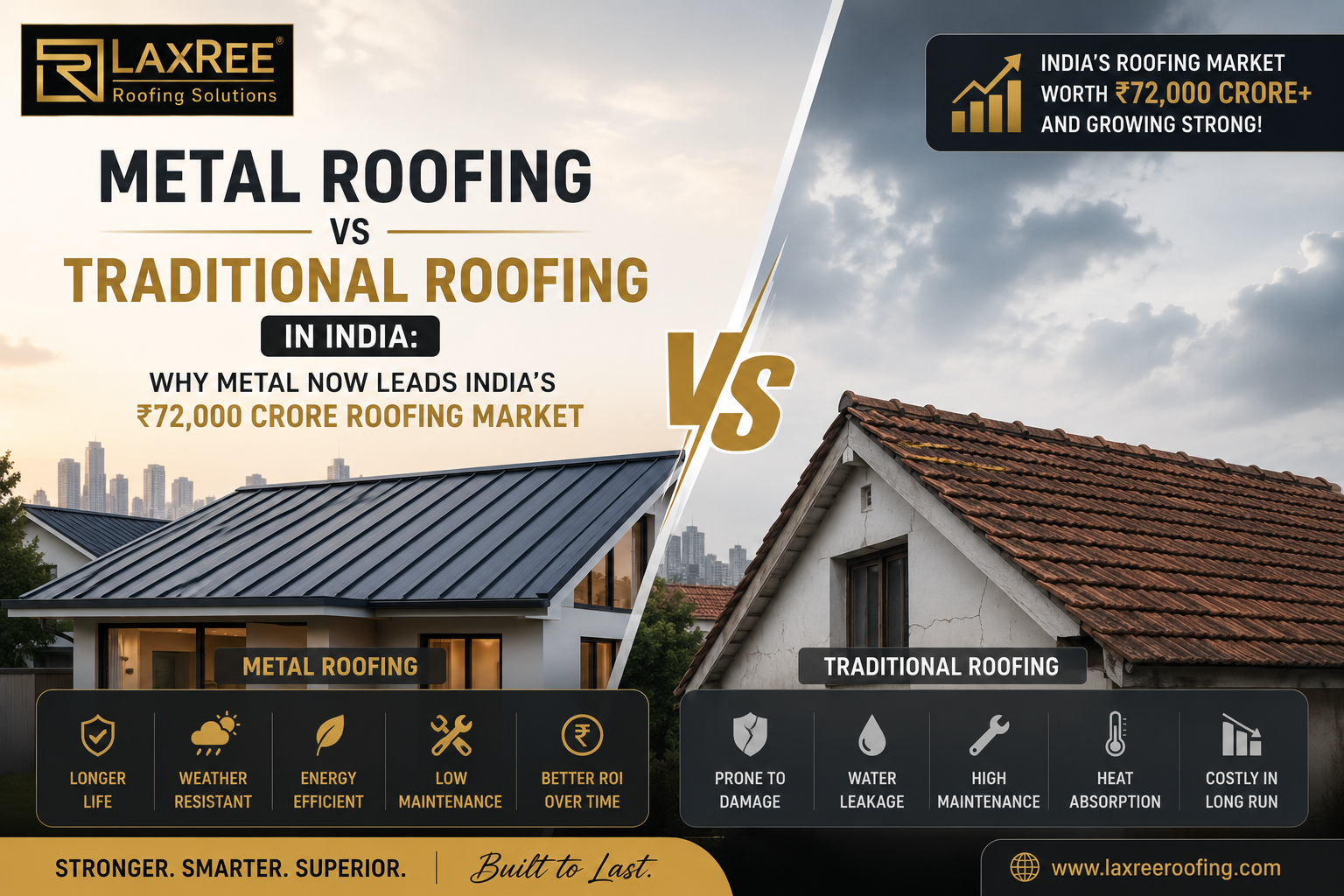
Metal Roofing vs Traditional Roofing in India: Why Metal Now Leads India’s ₹72,000 Crore Roofing Market
Something significant has happened in India’s roofing market that most homeowners and builders haven’t fully registered yet.
Metal roofing — including stone coated metal tiles, colour-coated steel sheets, and pre-engineered roofing systems — now holds 26.5% of India’s roofing market share in 2026, making it the single largest material category in the country’s ₹72,000 crore roofing industry. Pre-engineered buildings and steel-based roofing are witnessing double-digit growth, driven by demand from warehousing, industrial, and increasingly premium residential sectors.
This is a significant shift from even five years ago — when clay and concrete tiles dominated residential roofing and metal was largely associated with agricultural sheds and budget industrial construction.
What changed? And what does it mean for anyone making a roofing decision in India today?
This is the complete, honest comparison between metal roofing and traditional roofing in India — covering every dimension that actually matters for homeowners, builders, architects, and developers.
What “Traditional Roofing” Means in India
Traditional roofing in the Indian context covers the materials that have dominated residential and commercial construction for decades:
Clay tiles — particularly the Mangalore tile style across southern India, and various regional terracotta tile formats across the country. Natural, affordable, culturally familiar, but brittle, heavy, and moss-prone.
Concrete tiles — the urban and peri-urban workhorse of Indian residential construction through the 2000s and 2010s. More durable than clay, available in multiple profiles, but very heavy, prone to fading, and requiring regular repainting to maintain appearance.
Fibre-cement sheets — widely used in budget housing, rural construction, and institutional buildings. Inexpensive and fast to install but limited aesthetic appeal and a lifespan of 15 to 20 years before brittleness and cracking become issues.
These materials share several common characteristics: they are heavy, they require ongoing maintenance, they have finite lifespans that create replacement cycles, and their thermal performance in India’s demanding climate is limited.
What “Metal Roofing” Actually Covers in India
Metal roofing in India encompasses a wide range of products — and understanding the differences within this category is important before making any comparison.
Basic GI and colour-coated sheets — the budget end of the metal roofing spectrum. Corrugated or trapezoidal profile galvanised iron or colour-coated steel sheets. Widely used for industrial, agricultural, and budget residential construction. Fast to install, low upfront cost, but limited aesthetics and prone to corrosion at fastener points and cut edges without proper treatment.
Stone coated metal roof tiles — the premium end of the metal roofing category and the fastest-growing residential specification. A galvanised steel core coated with natural stone chips bonded using acrylic film. Combines the structural performance of engineered steel with the visual quality of natural stone or clay — and a 50+ year lifespan with zero maintenance.
Standing seam and architectural metal panels — premium commercial and institutional metal roofing used for airports, large commercial developments, and high-specification institutional construction.
When comparing “metal roofing vs traditional roofing” for Indian homeowners and residential developers, the most relevant comparison is between stone coated metal tiles and clay or concrete tiles — because these are the materials competing in the same premium residential specification space.
The Full Comparison: Stone Coated Metal Tiles vs Clay and Concrete
Lifespan
Clay tiles: 20–30 years with maintenance. In coastal, high-humidity, or seismic environments, significantly less.
Concrete tiles: 15–25 years. Fade and degrade faster without regular repainting.
Stone coated metal tiles (LaxRee): 50+ years — engineered lifespan backed by manufacturer warranty. In all Indian climate zones, across the full range of weather conditions India delivers.
Winner: Metal
Weight and Structural Load
Clay tiles: 35–45 kg per square metre. Requires significant structural reinforcement — heavier trusses, stronger beams, more robust wall structures. This structural cost is real and significant but rarely included in the roofing material’s per-square-foot quote.
Concrete tiles: 40–50 kg per square metre. The heaviest common roofing material in India. Maximum structural impact throughout the building frame.
Stone coated metal tiles (LaxRee): 7–10 kg per square metre — up to 75% lighter than concrete tiles. Directly reduces structural requirements throughout the frame, generating a cost saving that partially offsets the higher material price.
Winner: Metal — and significantly so in seismic zones where roof dead load is a structural safety consideration.
Weather and Monsoon Performance
Clay tiles: Moderate monsoon performance when intact. Brittle under impact — storm debris, hail, installation traffic all cause cracking that creates water entry points. In sustained high-rainfall environments, moss and algae growth accelerates tile degradation.
Concrete tiles: Good waterproofing when new. As surface sealant degrades with age, hairline cracks develop invisible to the naked eye that allow water infiltration under sustained rainfall. Very susceptible to moss and algae in humid environments.
Stone coated metal tiles (LaxRee): Interlocking tile design creates a continuous waterproof surface. Wind resistance up to 200+ km/h. Stone chip surface naturally resists moss and algae without any treatment. Galvanised steel core resists corrosion in coastal and high-humidity environments.
Winner: Metal
Thermal Performance
Clay tiles: Moderate thermal mass — absorbs heat during the day and releases it slowly at night. In high-heat zones like Rajasthan, this thermal lag means the roof continues radiating heat into living spaces well into the evening.
Concrete tiles: Similar to clay — significant thermal mass with poor heat dissipation after sunset.
Stone coated metal tiles (LaxRee): Heat-reflective stone chip surface reduces solar heat absorption at source. Steel core dissipates absorbed heat more efficiently than clay or concrete. In high-heat Indian climates, this translates into measurably lower interior temperatures and reduced cooling load — directly impacting electricity bills.
Winner: Metal
Maintenance Requirements
Clay tiles: Periodic moss and algae treatment, partial tile replacement for breakages, gutter cleaning required more frequently due to tile degradation debris.
Concrete tiles: Repainting every 5–8 years to maintain appearance and surface integrity. Moss treatment. Structural inspection as tiles age and hairline cracks develop.
Stone coated metal tiles (LaxRee): Zero maintenance required across the full lifespan. No repainting, no moss treatment, no structural inspection. The stone chip coating is inherently resistant to algae and fungal growth. The acrylic overglaze prevents UV fading.
Winner: Metal — decisively. This is the single largest total cost difference between metal and traditional roofing over a 30+ year ownership period.
Aesthetics and Design Flexibility
Clay tiles: Limited profiles, limited colour options. Traditional terracotta aesthetic that suits specific architectural styles but is difficult to integrate with contemporary design.
Concrete tiles: More profile variety than clay, but colour fades rapidly without maintenance. The appearance that makes concrete tiles attractive at installation degrades within a few years without repainting.
Stone coated metal tiles (LaxRee): Five distinct profiles — Classic, Roman, Milano, Bond, Shingle — plus a wooden texture variant that replicates real wood shake. Multiple colour options with UV-stable acrylic overglaze that holds colour permanently. Works with traditional, contemporary, Mediterranean, heritage, and modern minimalist architectural styles.
Winner: Metal — particularly for premium residential and hospitality architecture where the roof is a design element, not just a covering.
Fire Safety
Clay tiles: Non-combustible — a genuine advantage that clay maintains over organic materials.
Concrete tiles: Non-combustible.
Stone coated metal tiles (LaxRee): Fire-rated — non-combustible steel core. Meets residential and commercial fire safety requirements.
Winner: Tied — both traditional and metal tile roofing offer non-combustible performance.
Solar Compatibility
Clay tiles: Poor solar compatibility. Brittle under installation traffic, difficult to make watertight penetrations at mounting points, insufficient remaining lifespan to match a 25-year solar investment on older roofs.
Concrete tiles: Similar issues — heavy (limiting structural capacity for solar load), brittle at mounting points, lifespan mismatch for new solar investments.
Stone coated metal tiles (LaxRee): Strong solar compatibility — metal substrate provides secure, watertight mounting for solar racking systems. 50+ year lifespan matches and exceeds the solar investment period. Lightweight — maximum structural capacity available for solar panel load.
Winner: Metal
The Scorecard
| Factor | Clay Tiles | Concrete Tiles | Stone Coated Metal (LaxRee) |
|---|---|---|---|
| Lifespan | 20–30 yrs | 15–25 yrs | 50+ yrs ✅ |
| Weight | Heavy ❌ | Very heavy ❌ | 75% lighter ✅ |
| Monsoon performance | Moderate | Moderate | Excellent ✅ |
| Thermal performance | Poor–moderate | Poor–moderate | Heat-reflective ✅ |
| Maintenance | Medium | High | Zero ✅ |
| Aesthetics/profiles | Limited | Moderate | 6 options ✅ |
| Fire safety | Non-combustible ✅ | Non-combustible ✅ | Fire-rated ✅ |
| Solar compatibility | Poor | Poor | Excellent ✅ |
| Total cost (30 yrs) | High | Highest | Lowest ✅ |
Why Metal Roofing’s 26.5% Market Share Will Keep Growing
The data is clear — and the direction is consistent. <cite index=”18-1″>Metal roofing led India’s roofing market with a 26.5% share in 2026 because it fits industrial sheds, warehouses, and large commercial buildings where installation speed and durability matter.</cite> But in 2026, this is expanding rapidly into premium residential — driven by a generation of homeowners who are researching their options online, understanding total cost of ownership, and choosing the material that actually delivers the best long-term value.
The factors accelerating this shift:
- Rising buyer awareness of maintenance costs on clay and concrete
- Growing rooftop solar adoption creating demand for solar-compatible roofing
- Premiumisation of residential construction expectations in Tier 2 and Tier 3 cities
- Climate urgency driving demand for heat-reflective, energy-efficient materials
- Government green building mandates favouring energy-efficient roofing specifications
For any homeowner or builder making a roofing decision in 2026, the market trend and the performance data point in the same direction. Metal roofing — specifically stone coated metal tiles — is the specification that India’s most informed buyers are consistently choosing.
LaxRee Roofing — India’s Stone Coated Metal Tile Manufacturer
LaxRee Roofing manufactures premium stone coated metal roof tiles, synthetic thatch tiles, and asphalt shingles in Ajmer, Rajasthan — supplying residential, hospitality, and commercial projects across India at manufacturer-direct pricing.
Ready to make the switch to metal? Talk to LaxRee Roofing today.
📧 info@laxree.com | contactus@laxree.com 📞 +91 99822 86662 🌐 laxreeroofing.com
📍 Plot No. 1 & 2, Harbilas Sharda Marg, Civil Lines, Ajmer, Rajasthan


