
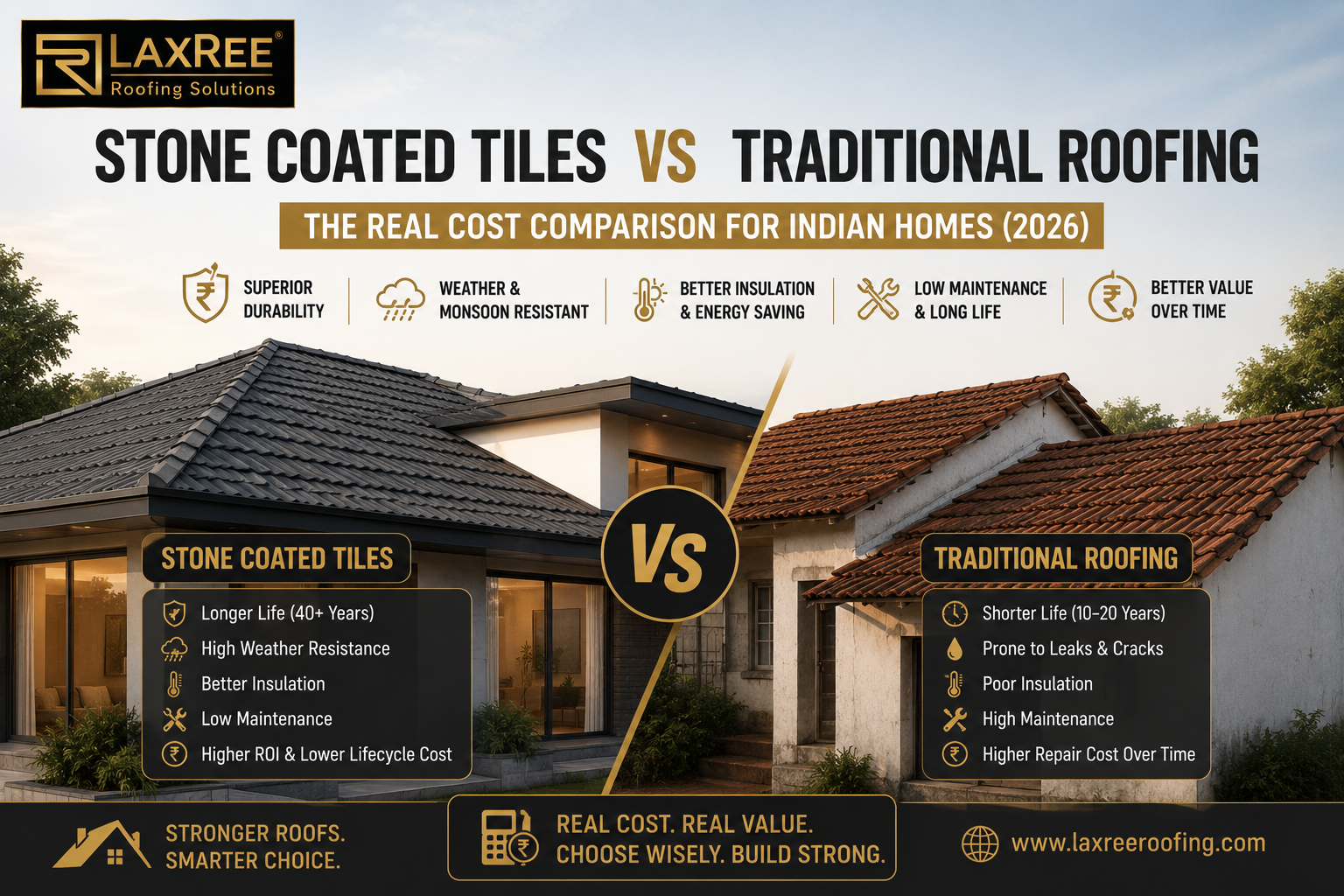
Stone Coated Tiles vs Traditional Roofing: The Real Cost Comparison for Indian Homes (2026)
Every roofing quotation in India leads with one number: cost per square foot. It’s the number that decides most conversations, and it’s also the number that tells you the least about what a roof is actually going to cost you.
A roof isn’t a one-time purchase. It’s a 25-to-40-year commitment, and traditional roofing materials — clay and concrete tiles especially — carry recurring costs that never appear on the original quotation: broken tile replacement, moss and algae treatment, resealing, and periodic waterproofing top-ups. None of these show up until year 5, year 10, year 15 — by which point most homeowners have long forgotten what the “cheap” option was supposed to save them.
This comparison lays out both numbers — installed cost and the maintenance cost that follows it — so the decision can be made on the full picture, not just the first line of the quote.
What Traditional Roofing Actually Costs, Installed (2026 India Rates)
Based on current published 2026 Indian market rates for tile roofing:
| Material | Installed Cost (₹ per sq ft) | Typical Lifespan* |
|---|---|---|
| Clay tiles | ₹80 – ₹150 | 30–50 years with consistent maintenance |
| Concrete tiles | ₹60 – ₹120 | 40–60 years with consistent maintenance |
| Metal / stone coated tiles | ₹100 – ₹200 | 25–50+ years, depending on coating grade |
| Waterproofing add-on (any tile roof) | +₹20 – ₹80 | Recurring — reapplied every few years |
*Lifespan figures assume proper maintenance is actually carried out on schedule. Skipped maintenance shortens all three materials considerably — it just shortens tile roofs faster.
On this table alone, concrete tiles look like the obvious budget winner. That’s exactly why the next section matters more than this one.
The Number Nobody Puts on the First Quotation: Maintenance
Every roofing material has a maintenance rhythm. The difference is whether that rhythm is priced into your decision upfront, or discovered one repair bill at a time.
Clay tiles: Individual tiles crack under impact, foot traffic, or thermal stress and need replacing — a recurring line item cited at roughly ₹20 per sq ft every 5 years in current market data, on top of periodic moss and algae cleaning. On a 1,000 sq ft roof, that’s roughly ₹20,000 per cycle, repeating for as long as the roof stands.
Concrete tiles: More resistant to cracking than clay, but the surface sealant that keeps them water-resistant degrades with age, and moss/algae growth in humid conditions is a well-documented recurring issue — meaning resealing and cleaning cycles rather than tile replacement.
Basic (uncoated) metal sheets: Need repainting roughly every 5–7 years to prevent rust, cited at around ₹15 per sq ft in current market data. This is specifically a bare-metal problem — it’s the surface coating that fails, not the metal underneath.
Any tile roof: Waterproofing isn’t optional, and it isn’t permanent. Adds ₹20–₹80 per sq ft to the initial cost, and needs reapplication on a cycle of its own, separate from the tiles themselves.
Add up enough of these cycles over 25 years, and the “cheaper” material on day one is rarely the cheaper material by year 20.
Where Stone Coated Metal Tiles Change the Equation
Stone coated tiles sit at the upper end of the installed-cost bracket — ₹100–₹200 per sq ft — which means they don’t win the comparison on sticker price. They win it on what happens after installation, for a few specific engineering reasons:
The stone-chip coating removes the repaint cycle. Unlike bare metal sheets, the factory-applied stone-chip surface is the protective layer itself — not a paint coat sitting on top of unprotected metal. There’s no ₹15/sq ft repaint bill waiting at year 5.
No organic surface means no moss or algae. Clay and concrete tiles are porous, mineral surfaces — exactly what moss and algae need to establish. A stone-coated surface gives biological growth nothing to hold onto, removing the most common cause of progressive tile-edge lifting and leakage in traditional roofs.
The interlocking profile is the waterproofing. Instead of relying on a separate chemical membrane that needs periodic reapplication, the tile-to-tile overlap is engineered to shed water on its own. That’s the ₹20–80/sq ft recurring waterproofing line item designed out of the equation, not discounted.
Significantly lighter than clay or concrete. Clay and concrete tiles are heavy — heavy enough that some roof structures need additional reinforcement to carry them, an upfront structural cost that rarely appears on the initial tile quotation. Lighter stone coated metal tiles reduce or eliminate that risk entirely, which matters particularly on re-roofing projects over an existing structure.
The 25-Year View: Why the Numbers Flip
Here’s the same comparison, but extended across a realistic roof lifespan for a 1,000 sq ft roof, using the market rates above as an illustrative baseline:
Clay tile roof: Installed cost ₹80,000–₹1,50,000. Add tile replacement and repair at roughly ₹20,000 per 5-year cycle — around four more cycles across 25 years — and you’re looking at up to ₹80,000 in additional maintenance, before counting moss removal or waterproofing renewal. Realistic 25-year figure: well above the installed cost alone.
Concrete tile roof: Installed cost ₹60,000–₹1,20,000, the cheapest entry point of the three. The ongoing cost driver here is resealing and moss/algae treatment rather than tile replacement — smaller individual bills, but recurring for as long as the roof is in service.
Stone coated metal tile roof: Installed cost ₹1,00,000–₹2,00,000 — the highest starting number on this table. But because the repaint cycle, the tile-replacement cycle, and the waterproofing-reapplication cycle are all designed out of the system, the installed cost sits close to the actual 25-year total, rather than being the opening bid in a series of future invoices.
These figures are indicative, based on published 2026 Indian roofing market rates. Actual costs vary by city, roof complexity, and site conditions — get a firm, project-specific quote before budgeting.
The Real Question to Ask Before You Choose
Not “which roof costs less per square foot” — but “how many more times will I pay for this roof after I’ve already paid for it once?”
For a roof you plan to replace within 10–15 years anyway, or where upfront budget is the only real constraint, clay or concrete tiles remain a reasonable, well-understood choice. For a roof meant to last 25+ years with the fewest possible maintenance calls, repaint jobs, and monsoon-season surprises, stone coated metal tiles are built specifically to remove the recurring costs that traditional roofing carries by design.
Want the exact installed cost and 25-year maintenance comparison for your specific project? Talk to LaxRee Roofing.
📧 info@laxree.com | contactus@laxree.com 📞 +91 99822 86662 🌐 laxreeroofing.com 📍 Plot No. 1 & 2, Harbilas Sharda Marg, Civil Lines, Ajmer, Rajasthan


