
Stone Coated Roofing Tiles: Full Product Guide — What They’re Made Of, How They Perform, and Why They’re Replacing Traditional Roofing in India (2026)
Monsoon leaks, summer heat, and the long-term cost math of re-roofing every few years all trace back to the same root decision: what the roofing material is actually made of. Every earlier problem we’ve covered — moss growth, fastener corrosion, thermal cracking, recurring waterproofing bills — has a direct engineering answer in how a roofing tile is built, layer by layer.
This guide is the deep dive on the product itself: what a stone coated roofing tile is, exactly what each layer does, the specifications that actually matter, and a practical checklist for anyone evaluating tiles before placing an order.
What Is a Stone Coated Roofing Tile?
A stone coated roofing tile is a steel roofing panel — engineered for strength and shaped to interlock like a traditional tile — that’s coated with natural stone granules and sealed under a protective glaze. The result combines the structural performance of metal roofing with the traditional tile, shake, or slate appearance that steel alone can’t deliver. It isn’t a stone product and it isn’t a painted metal sheet — it’s a multi-layer composite where each layer does a specific job.
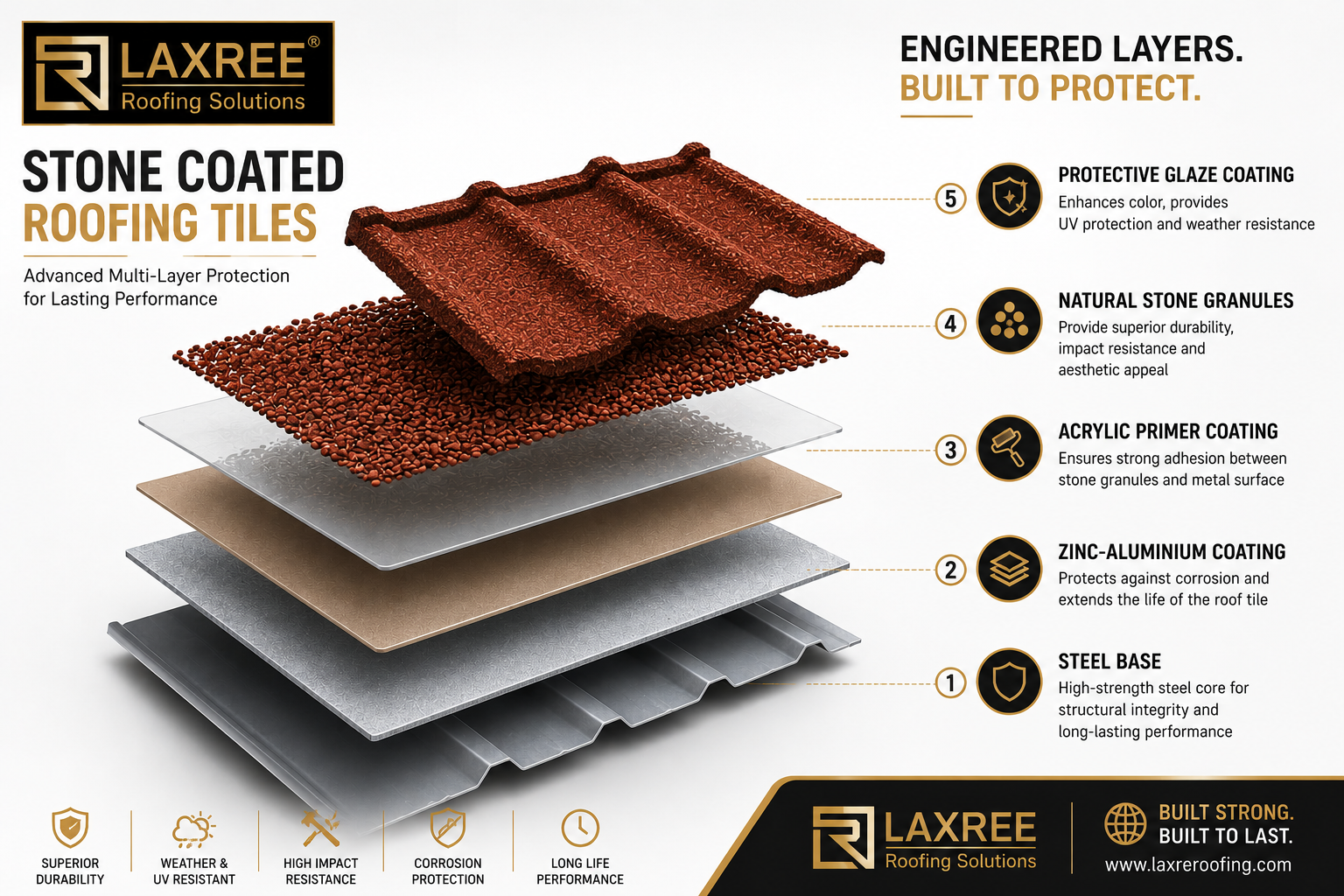
The Construction — Layer by Layer
Reputable stone coated tile manufacturing follows the same basic layer sequence, tested in independent labs for resistance to water, salt, acid, alkalines, heat, fire, and repeated freeze-thaw cycling:
1. High-strength steel base. The structural core of the tile — this is what carries load, resists impact, and gives the tile its rigidity and interlocking strength.
2. Zinc-aluminium (Galvalume) alloy coating. Applied directly onto the steel base, this is the primary corrosion-resistance layer. Galvalume-coated steel is documented to resist corrosion significantly longer than plain galvanized (zinc-only) steel, and it also reflects more solar radiation — which is part of why properly coated metal tiles run cooler than bare galvanized sheets.
3. Acrylic primer / base coat. A bonding layer that ensures the stone granules adhere permanently to the coated steel rather than sitting loosely on top of it.
4. Natural stone chip granules. Embedded into the primer layer, these granules give the tile its color, texture, and — functionally — its UV protection, impact resistance, and surface noise reduction during rainfall.
5. Acrylic overglaze / protective seal. The final layer, baked on for adhesion, which locks the stone granules in place, adds brightness and water resistance, and resists moss and algae growth on the surface.
This layered approach is why quality stone coated tiles are lab-rated across multiple resistance categories at once — water, heat, fire, salt, freeze-thaw — rather than being strong against one threat and weak against another, which is the common failure pattern in single-material roofing like plain clay, concrete, or bare metal.
Key Technical Specifications
| Specification | Typical Range (Industry Standard) |
|---|---|
| Base material | Galvalume steel — steel core with Zinc-Aluminium (Al-Zn) alloy coating |
| Steel thickness | Typically 0.4mm – 0.5mm gauge (varies 0.18mm–0.6mm by grade) |
| Standard tile size | Approx. 1340mm x 420mm per panel |
| Coverage per tile | Approx. 0.45 – 0.48 sq. m |
| Fire rating | Class A (highest available fire-resistance rating; non-combustible) |
| Wind resistance | Engineered interlocking system rated for high wind uplift resistance |
| Manufacturer warranty | Typically 25–50 years, depending on manufacturer and grade |
| Expected lifespan | Typically 40–50 years with proper installation |
| Weight vs. clay/concrete | Substantially lighter — commonly cited as a fraction of the weight per sq ft |
Always confirm exact figures with your supplier’s technical data sheet — grade, coating thickness, and warranty terms vary meaningfully between manufacturers, and this is exactly what the buyer’s checklist below covers.
Why Each Layer Matters (Not Just Marketing Language)
Steel core + Galvalume coating = strength without the weight penalty. Traditional clay and concrete tiles rely on mass for durability, which is exactly why they’re heavy enough to sometimes require structural reinforcement. A steel core delivers comparable — often superior — impact and wind resistance at a fraction of the weight, without asking the building structure to carry more load than necessary.
The stone chip layer is functional, not just decorative. It’s the UV shield that prevents the steel and coating underneath from degrading under constant sun exposure, it absorbs impact from hail or debris before it reaches the steel, and it noticeably reduces the drumming sound of heavy rain compared to bare metal sheeting — a detail that matters a lot more once you’ve lived under one during a monsoon downpour.
The acrylic overglaze is what makes the color permanent. Painted roofing surfaces fade and chalk under UV exposure over a few years. A properly sealed stone-chip surface doesn’t rely on pigment stability the same way — the color comes from the mineral granules themselves, sealed under glaze, which is why quality stone coated tiles hold their appearance for decades rather than needing a repaint cycle.
The interlocking profile is the waterproofing system. Instead of depending on a separate chemical membrane, the physical overlap between tiles is engineered to shed water on its own — and the same interlock that keeps water out also distributes wind load across the roof instead of concentrating it at individual tile edges, which is what causes wind-driven tile lifting on lower-grade roofing.
Design & Profile Options
Stone coated tiles aren’t limited to one look. Manufacturers typically offer several profiles to match different architectural styles:
- Roman / classical tile profiles — replicate traditional clay tile roofing without the weight or cracking risk
- Shake / shingle profiles — replicate wood shake or asphalt shingle aesthetics without rot, warping, or high maintenance
- Flat / slate-inspired profiles — a cleaner, more modern architectural look
- Multiple color options — including dual-tone finishes, which generally read as more dynamic and visually rich than flat single-tone colors
If heat performance matters for your project — and for most of India, it should — lighter shades reflect meaningfully more solar radiation than dark tiles, directly reducing roof surface temperature. (For the full science on this, see our Cool Roof Technology guide.)
Where Stone Coated Tiles Are Actually Used
- Residential homes and villas — as a direct upgrade from clay or concrete tile roofing
- Commercial buildings — where long service life and low maintenance reduce facilities-management overhead
- Hospitality and resort properties — where roof appearance, noise reduction, and heat performance all directly affect guest experience
- Renovation and re-roofing projects — the light weight often allows installation over a single layer of existing roofing material in many cases, though this always needs structural and code verification before proceeding, not assumed by default
What to Check Before You Buy: A Practical Checklist
A roofing quotation can say “premium stone coated tile” and still vary enormously in actual quality. Before ordering:
1. Confirm the actual steel gauge/thickness in writing. “Heavy duty” is not a specification — a millimetre thickness figure is.
2. Ask for the Al-Zn coating percentage. A 55% aluminium-zinc alloy coating is the recognized benchmark for long-term corrosion resistance — lower percentages compromise the entire corrosion-resistance case for choosing steel in the first place.
3. Get warranty terms in writing, and read what’s actually covered. Material warranty, fade/color warranty, and wind/hail warranty are frequently three separate things with three separate terms — a long headline warranty number means little if it only covers manufacturing defects and nothing else.
4. Physically inspect the interlocking mechanism, not just a photo of it. Ask to see how adjacent tiles overlap and lock — this is the actual waterproofing and wind-resistance system, and it’s worth handling before you commit to a full roof’s worth.
5. Ask how the stone chips are bonded. Poured and baked bonding processes hold granules far more securely over time than sprayed-on application — granule shedding over the years is one of the most common quality failures in lower-grade stone coated tiles, and it’s not visible on day one.
6. Request test certifications. ISO 9001 manufacturing certification, fire rating documentation, and wind-load test data should be available on request from any manufacturer confident in their product — if they aren’t, that’s the answer to the question.
The Bottom Line
A stone coated roofing tile is only as good as its weakest layer — and every layer above is designed to solve a specific traditional-roofing problem: weight, corrosion, UV fade, water ingress, moss growth, and wind uplift. Understanding the construction isn’t just technical interest — it’s exactly what separates a roof that performs for 40+ years from one that starts showing problems in year 5.
Want the full technical data sheet and warranty terms for LaxRee’s stone coated roofing tiles? Get in touch.
📧 info@laxree.com | contactus@laxree.com 📞 +91 99822 86662 🌐 laxreeroofing.com 📍 Plot No. 1 & 2, Harbilas Sharda Marg, Civil Lines, Ajmer, Rajasthan


